blog article
Wi-Fi Turns 27 — And It's Never Been More Essential
June 20 is World Wi-Fi Day, and the technology under almost every digital moment of modern life turns 27. From black-hole astronomy to mission-critical infrastructure — and why Wi-Fi 8 trades "how fast" for "how certain."
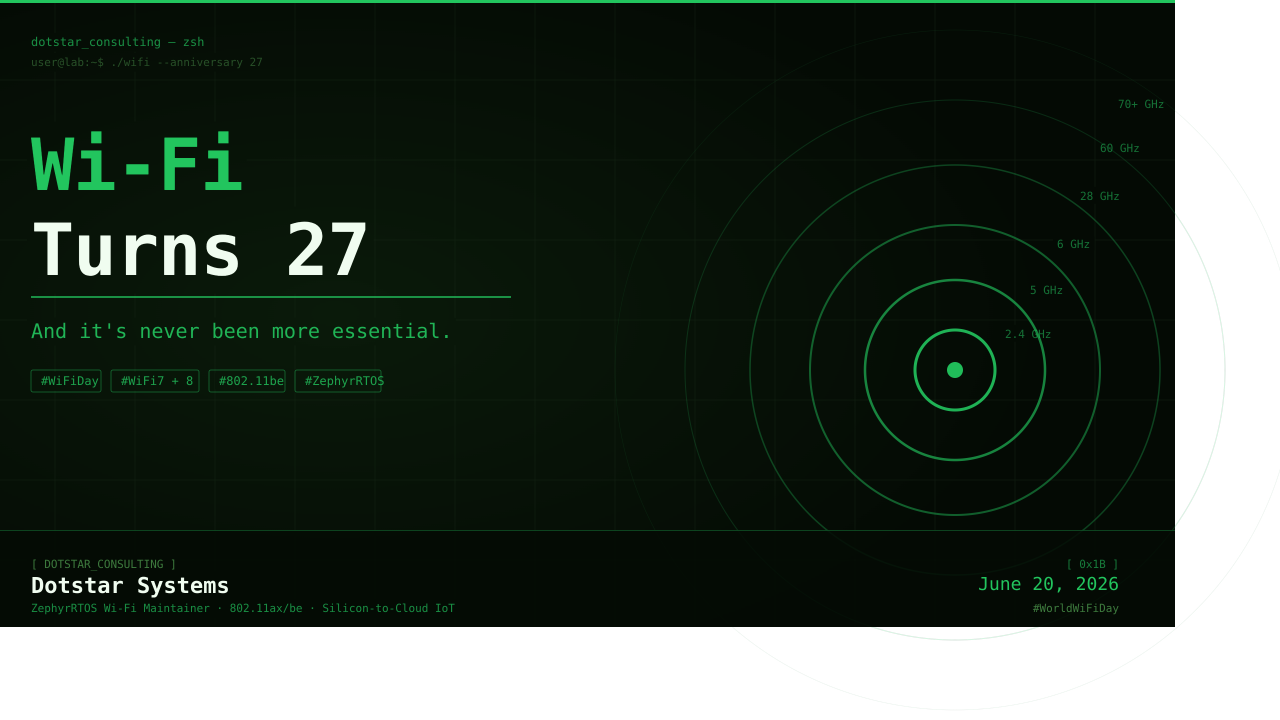
June 20 is World Wi-Fi Day. This year, the technology running under almost every digital moment of modern life turns 27.
Not bad for something born from failure.
Born From a Search for Black Holes
Before there was Wi-Fi, there was a team of Australian radio astronomers at CSIRO trying to detect exploding miniature black holes the size of atomic particles. They didn’t find any.
But in trying to pull faint cosmic signals out of deep-space noise, Dr. John O’Sullivan and colleagues applied FFT-based OFDM techniques to solve multipath interference in wireless LANs — the specific engineering insight CSIRO patented, and what became the core of 802.11. When the wireless networking challenge emerged in the early 1990s (radio signals bouncing off walls, chairs, ceilings), they realized they’d already solved it. CSIRO patented the method in 1992 and 1996. It became the core of IEEE 802.11.
From 2.4 GHz to 70+ GHz
Wi-Fi has never stayed in one lane. What started on a single 2.4 GHz band at 11 Mbps in 1999 now spans:
- 2.4 / 5 / 6 GHz — the consumer and enterprise stack, from 802.11b to Wi-Fi 7’s 46 Gbps
- 900 MHz (HaLow) — long-range, low-power, built for IoT at the edge
- 28–60 GHz (mmWave) — where Wi-Fi converges with 5G-NR for dense industrial deployments
- 70+ GHz → Wi-Fi 8 — and here’s the shift worth paying attention to: Wi-Fi 8 (802.11bn) isn’t chasing another speed record. Its design thesis is ultra-high reliability — deterministic, consistent performance for mission-critical systems. The move from “how fast” to “how certain” is the maturation signal of infrastructure technology.
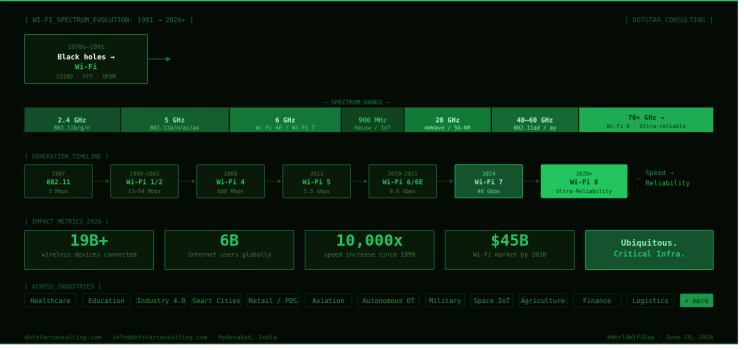
Ubiquitous. Critical. Invisible.
- 19B+ wireless devices connected today
- 6B global internet users, most of them on wireless
- 10,000× speed increase since 1999
- Wi-Fi market growing to $35–45B by 2030
- Wi-Fi 7 adoption scaling 3× faster than any prior generation
We’ve stopped noticing Wi-Fi — the same way we stopped noticing electricity. You only notice it when it’s gone. Hospitals, factory floors, logistics hubs, aircraft cabins, financial trading systems — in every one of these environments, wireless connectivity has moved from convenience to critical path.
That’s the real story at 27. Not just faster speeds. Critical infrastructure.
Across Every Industry — Including Yours
At Dotstar Systems, the questions we work through — at the firmware and silicon level, in ZephyrRTOS, hostap, and 802.11ax/be drivers — have completely changed.
Nobody asks “can we get Wi-Fi here?” anymore.
The questions are: How do you support 400 IoT endpoints and 3 network slices on one physical infrastructure with zero cross-contamination? How do you run a certified Wi-Fi stack on 512KB of RAM? How do you build for seamless roaming at the edge without packet loss?
Wi-Fi at 27 is the question underneath almost every connected product and system being built today — in healthcare, Industry 4.0, agriculture, aviation, logistics, defense.
One More Thing
Over 1 billion people still have no reliable internet access. World Wi-Fi Day is a celebration — and a reminder. The best version of Wi-Fi’s next 27 years closes that gap.
Happy World Wi-Fi Day. 📶